
If you are relying on standard nylon webbing to secure a ten-pound fire extinguisher or a zeroed rifle, you are eventually going to experience shifting gear and compromised indexing due to fabric stretch.
so Switching to a polymer or aluminum chassis provides distinct Rigid MOLLE advantages, specifically eliminating the “sag and drag” effect inherent to flexible PALS grids found in standard vehicle organizers.
Disclosure: All products have affiliate links for earning commission to support the website when you purchase
| Model Type | Material Spec | Footprint | Best Application |
|---|---|---|---|
| Seat Back RMP | High-Density Polyethylene (HDPE) | 15.25″ x 25″ (Universal) | Vehicle Quick Deployment |
| Hard Case Lid Panel | Glass-Reinforced Polymer | Case Specific (Start at 15″) | SBR & Suppressor Org |
| Quick Fist Clamp | Heavy Duty Transportation Rubber | Single Point Mount | Axes & Shovels |
The Structural Failure of “Soft” Storage
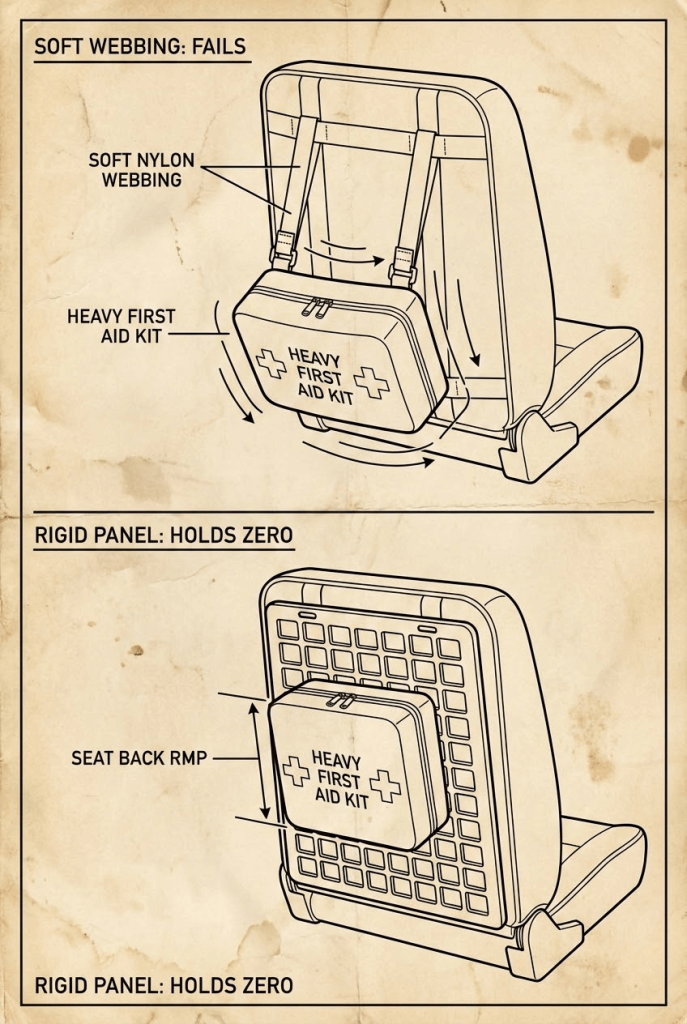
I learned the hard way that fabric webbing is designed for body armor, not vertical storage walls. When you attach a fully loaded IFAK or a sledgehammer to a nylon panel hanging on a car seat, gravity takes over. In my testing, standard PALS webbing stretches under sustained load, creating what we call the “sag and drag” effect. The pouch droops, opening gaps in the mounting grid. This isn’t just cosmetic; it ruins your index points.
Muscle memory relies on the gear being in the same coordinate every time you reach for it. If a hard brake causes your med kit to swing or drop two inches because the fabric backing gave way, you fumble. Rigid platforms, acting much like an aluminum bedding block in a rifle stock, isolate the weight of the pouch from the mount. This ensures that when you reach for a magazine, it is exactly where you staged it.
1. Vehicle Seat Back RMP (Grey Man Tactical Style)
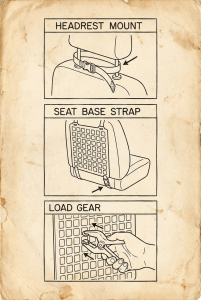
For vehicle setups, swapping cheap neoprene organizers for a High-Density Polyethylene (HDPE) panel is the standard upgrade. These panels allow for “stand-off” mounting using straps that loop around the headrest and seat base. Unlike fabric, the HDPE does not absorb water, oil, or mud, which prevents grit from getting embedded in the weave and sanding down the finish of your stored firearms.
Prices for these systems have stabilized recently. While a full kit used to cost significantly more, you can generally find a standard seat-back panel regularly listed around $150, but currently available for $120 depending on the mounting hardware package.
2. Hard Case Lid Organizers
We often waste the lid space in Pelican or Nanuk cases by leaving the standard egg-crate foam installed. By screwing a Rigid MOLLE panel into the lid bosses, you create a second layer of active storage. This is critical for stabilizing heavy items like loose magazines or suppressors that usually migrate to the bottom of the case during transport. The rigidity of the panel distributes the weight across the lid structure rather than stressing a single screw point.
You can typically anchor a high-quality lid panel for around $55 – $80, which saves you the cost of buying a larger, secondary case.
Material Nuance: Aluminum vs. Polymer
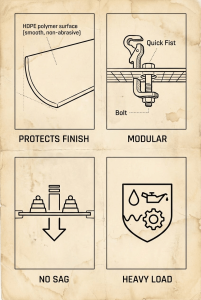
There is a misconception that “rigid” must mean metal. For 90% of civilian and law enforcement applications, HDPE polymer is the superior choice over aluminum. Aluminum is heavier, more expensive, and—crucially—abrasive. If you mount a rifle directly to an aluminum grid without a buffer, vibration will scuff your receivers. Polymer panels are softer than your gun’s anodizing, protecting the finish.
Aluminum should be reserved for high-heat environments, such as mounting directly next to a vehicle transmission tunnel or engine bay firewall where polymer might warp.
3. “Hackable” Retention: Quick Fists and Shock Cord
The true utility of a rigid grid is the ability to mount non-MOLLE items. I frequently use Quick Fists—heavy rubber clamps—bolted directly through the 1.5″ holes. These are the only reliable way to secure irregular objects like shovel handles or flashlight bodies that would slip out of a nylon pouch. Furthermore, because the holes are laser-cut and rigid, you can weave shock cord through them to create custom tension loops for tourniquets, something impossible to do securely on floppy fabric webbing.
A set of mounting clamps is a cheap addition, usually priced at $11 for a pair.