
Finding the Best EDC Pocket Organisers is critical to avoiding the “brick effect,” where stiff 1050D nylon creates an uncomfortable, visible block in your front pocket that destroys discretion.
Dealing with “yard sale” spills from non-gusseted clamshells drove me to test these top-tier solutions that actually secure your tools rather than just storing them.
Disclosure: All products have affiliate links for earning commission to support the website when you purchase
| Model | Capacity/Spec | Footprint | Best Application |
|---|---|---|---|
| Maxpedition Micro | 1050D Ballistic Nylon | 3.5″ x 5.5″ (Rigid) | Hard-use / Cargo Pockets |
| Helikon-Tex Mini Service | 500D Cordura | 4.5″ x 5.5″ (Flexible) | Front Pocket / Medical Kit |
| Viperade VE1 | 500D Polyester (Hybrid) | 4.5″ x 6.3″ (Slim) | Quick Access / Flashlights |
The “Brick Effect” and Material Nuance
The biggest battle in pocket carry is the trade-off between durability and comfort. Many users immediately grab the thickest fabric available, assuming “toughest” means “best.” In my testing, high-denier fabrics like Maxpedition’s 1050D Ballistic Nylon act like sandpaper against thigh skin and pocket linings.
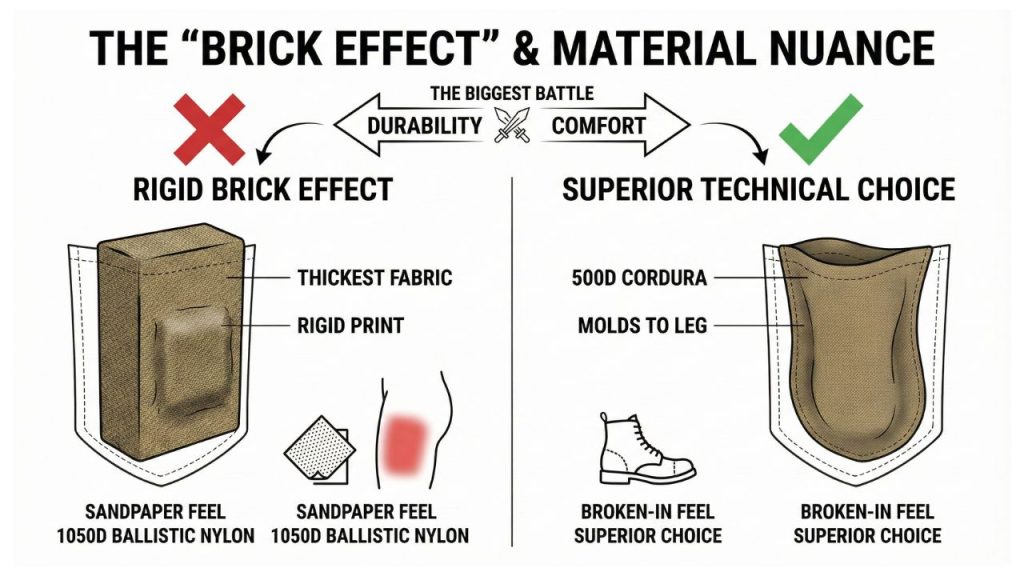
For a dedicated front-pocket kit, 500D Cordura—used by brands like Helikon-Tex—is the superior technical choice. It molds to the leg like a broken-in leather boot, eliminating the rigid rectangular print that makes you look like you are carrying a literal brick.
Maxpedition Micro Pocket Organizer
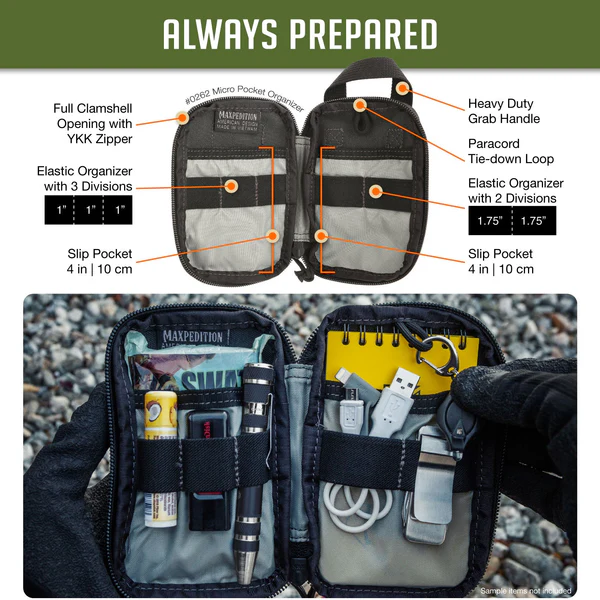
This is the industry standard for a reason, but it comes with caveats. Maxpedition utilizes a Teflon fabric protector that makes this organizer virtually waterproof and grime-resistant. The stitching is over-engineered, meaning you can overstuff it without blowing out the coil zippers.
However, the internal elastic loops are tight; they fit Fisher Space Pens and AAA lights perfectly, but thicker 18650 flashlights will struggle to fit. It uses a clamshell opening, but the stiffness of the material acts as a natural limiter, preventing it from flopping open entirely.
Pricing usually sits at an MSRP of $32, but you can often find it marked down to around $26.
Helikon-Tex Mini Service Pocket
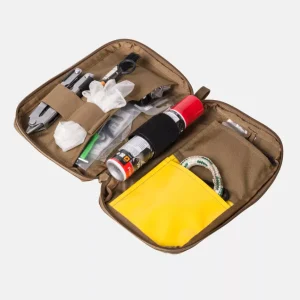
If the Maxpedition is a tank, the Helikon-Tex is a refined sedan. The primary differentiator here is the 500D Cordura construction. It feels significantly softer in hand and conforms to the body when seated, reducing the pressure points on the sciatic nerve if you carry it in a back pocket. The internal layout is distinct; instead of just vertical loops, it includes a darker, high-contrast interior often utilized in medical kits. This makes identifying small silver tools or dark bits much easier in low-light conditions.
These are generally cleaner on the budget, usually available for roughly $24.
Viperade VE1 Hybrid Pouch
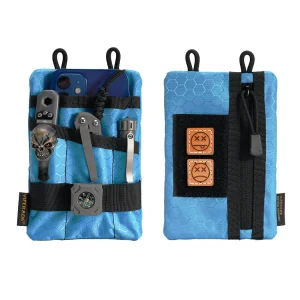
The Viperade VE1 solves the “Inaccessible Quick Access” problem. Traditional organizers require a “surgery” maneuver: remove pouch, unzip, extract tool, re-zip, stow. The VE1 is a hybrid sheath/pouch. It features open-top biased slots on the exterior for your knife and flashlight, allowing for immediate deployment without opening the main compartment. The zippered section is reserved for cash, cards, or small items that would otherwise get lost. The polyester construction is less rigid than 1050D nylon, keeping the profile slim even when loaded.
This is the budget king, often selling for under $18.
Avoiding the “Yard Sale” Opening
A common failure point in cheaper organizers is the lack of gussets on a 180-degree clamshell zipper. If you are holding the pouch vertically and unzip it fully, gravity takes over, and your expensive gear spills onto the floor—the dreaded “yard sale.” Brands like Alpaka (specifically the Hub Pouch) and high-end drop brands like Garage Built Gear fix this with stiffened sidewalls or restricted zippers that create a “shelf” when opened. If you already own a pouch that flops open, you can stitch a small limiter cord near the bottom hinge to artificially restrict the opening angle.
The Budget Alternative: Chums Surfshort Wallet

You do not always need “tactical” gear. The Chums Surfshort Wallet is a dual-zipper pouch originally designed for surfers, but it has been adopted by the EDC community for micro-kits. It is made of rip-stop nylon, weighs almost nothing, and features a clear ID window. It has zero elastic organization inside, meaning your tools essentially float loose, but for a minimalist setup (Swiss Army Knife + Bic Lighter + Cash), it eliminates all bulk.
It is unbeatable for value, typically costing around $12.