
Disclosure: All products have affiliate links for earning commission to support the website when you purchase
| Model | Material Spec | Footprint | Best Application |
|---|---|---|---|
| BuiltRight Industries Tech Plate | CNC Laser Cut Aluminum | Truck Bed (Side Wall) | Heavy Extrication Tools & Jacks |
| Grey Man Tactical RMP | High-Density Polyethylene | Seat Back (Vertical) | Firearms, Med Kits, Electronics |
| Blue Ridge Overland Gear | 500D Cordura w/ Stiffener | Seat Back (Soft) | Soft Goods, Maps, Daily Carry |
Rigidity vs. Rattle: Understanding Material Selection
In my experience outfitting expedition rigs, the primary failure point of any MOLLE system is the material’s reaction to vibration and heat. While steel offers magnetism for easy tool attachment, I have found it adds unnecessary unsprung weight and acts as a massive heat sink. If you park your rig in direct sunlight, a black powder-coated steel panel on a seat back can reach temperatures high enough to damage sensitive aerosols or electronics mounted to it.

The industry standard for serious overland builds is now aluminum or rigid polymer. Aluminum creates a balance of rigidity and weight savings, but it requires rubber washers or felt tape to dampen the “tuning fork” effect caused by metal carabiners hitting the grid on washboard roads. Polymer, specifically the High-Density variants, eliminates the corrosion issue entirely and returns to shape if bent, but lacks the absolute structural hold required for mounting a high-lift jack.
Top Tier Loadout Solutions
BuiltRight Industries Bedside Rack Systems

For those running a Toyota Tacoma or Ford F-150, BuiltRight solves the biggest headache of bed organization: the drill. I prefer these panels because they utilize OEM factory mounting points (bed cleats) suitable for securing heavy rotational mass items. The grid spacing is precise, adhering to the standard 1-inch PALS spec, which prevents the frustrating pouch-bunching seen on cheaper imported knock-offs.
You can usually find a full driver-side system regularly priced around $275, but I often see them available for closer to $240 during seasonal sales.
Grey Man Tactical Rigid MOLLE Panel (RMP)
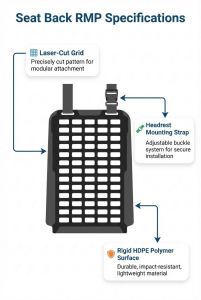
If your goal is interior gear retention without the risk of creating a projectile, the Grey Man Tactical RMP is the superior choice. I have tested these with fully loaded rifle racks and heavy breach tools; the polymer composite does not sag. The critical advantage here is safety; unlike steel panels that can interfere with seat crumple zones or become sharp hazards in a crash, the RMP is designed to be tough yet safe for cabin use.
A standard 15.25″ x 25″ seat back panel commonly retails for $150, but you can grab a streamlined setup for $115.
Blue Ridge Overland Gear Seat Back Panel

Sometimes you don’t need a tactical breaching tool setup; you just need a place for wet wipes and rain gear. Blue Ridge bridges the gap between saggy cheap organizers and hard-mounted plates. They use internal stiffeners sandwiched between layers of Cordura. This prevents the top corners from curling inward—a constant annoyance with generic Amazon organizers—while keeping the surface soft enough that it won’t injure a rear passenger’s knees during a sudden stop.
These units sit at a premium price point, regularly $180, often found for $160.
Installation Nuances and Hazard Avoidance
The Airbag Oversight: A dangerous trend I see in the MOLLE panel for truck community is strapping rigid panels over seats equipped with side-curtain airbags. If a strap encircles the deployment seam, the airbag may rupture the strap, fail to deploy, or turn the panel into shrapnel. Always route mounting straps under the fabric skin of the seat or use hard-mount points on the headrest posts and seat rails that bypass the bolster entirely.
The “Quick Fist” Hack: Stop trying to weave MOLLE straps for round tools like axes or flashlights. It is inefficient and floppy. I recommend drilling out two grid holes slightly (if using polymer/metal) and bolting “Quick Fist” rubber clamps directly to the panel. This provides a zero-rattle hold that weaving simply cannot replicate.
Solving the Blind Spot: Rear window panels are excellent for vertical storage but terrible for highway visibility. Once fully loaded with pouches, you effectively lose your rear-quarter sightline. If you must use a window grid, I suggest limiting it to flat items like First Aid patches or slim maps, rather than bulging medical kits that obscure lane changes.