
Most “gray man” packs collapse into a lumbar-straining lump I call the “soup sandwich” effect because they lack internal framing to handle heavy loads. Rigid MOLLE Panels (RMP) solve this by functioning as a modular frame sheet, keeping heavy gear vertical and tight against the harness rather than pooling at the bottom of the bag.
Disclosure: All products have affiliate links for earning commission to support the website when you purchase.
| Model | Material/Spec | Footprint | Best Application |
|---|---|---|---|
| Grey Man Tactical RMP | High-Density Polyethylene (HDPE) | Various (10×15″ up to Seat Back) | Universal Bag Inserts & Vehicle Racks |
| BuiltRight Tech Plates | Powder Coated Steel / Aluminum | Vehicle Specific (OEM Fit) | Hard-mounted Dash & Trim Storage |
| 5.11 Hexgrid | Laminate / Nylon | Shoulder Bag / Backpack Insert | Multi-angle (45-degree) Access |
Solving the “Soup Sandwich” with Grey Man Tactical
The primary issue with transitioning from a framed ruck to a civilian EDC bag is the center of gravity. When you drop loaded magazines, a radio, or a heavy medical kit into a standard nylon bag, gravity pulls everything to the lowest point. This pulls the backpack away from your shoulders, significantly increasing fatigue.
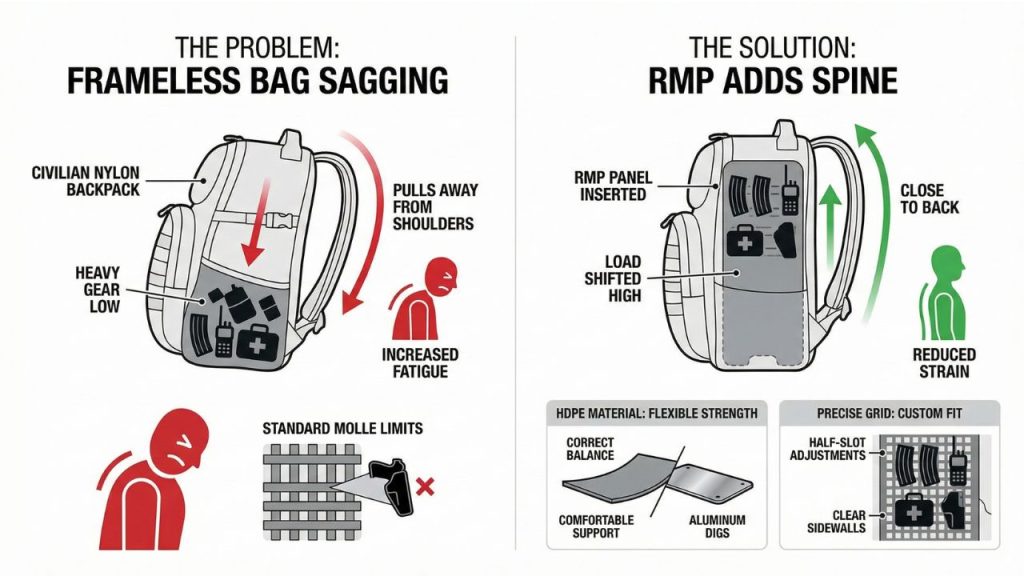
The Grey Man Tactical RMP series effectively adds a spine to frameless bags. They utilize High-Density Polyethylene (HDPE), which strikes the correct balance between rigidity and shatter resistance. Unlike aluminum panels I have tested in backpacks, the HDPE has enough flex to conform slightly to a curved back panel without digging into your kidneys, but remains stiff enough to support a mounted rifle or heavy hydration bladder without buckling.
The pixel density of their mounting grid allows for “half-slot” adjustments. This is critical when trying to clear the sidewalls of a backpack; standard MOLLE webbing often forces you to mount a holster either too high (interfering with the zipper) or too low (unreachable). The RMP grid lets you bridge slots for custom ergonomics.
Recommended: GMT Vehicle Seat Back Organizer
For vehicle operations, sagging is the enemy. Cheap nylon seat organizers turn into swinging pendulums during hard cornering. The RMP 15.25″ x 25″ panel provides a static mounting platform. While full kits with rifle clamps can run upwards of $450, you can usually snag the bare panel for around $115 and rig your own retention.
The most common error I see is ordering a panel that matches the bag’s exterior dimensions exactly. If your backpack is 19 inches tall, do not buy the 19-inch panel. You must account for the internal zipper radius at the corners. A rectangular panel will jam into the rounded corners of a pack, stressing the zipper teeth until they fail. I always size down by at least 1 inch on all sides (e.g., use a 17-inch panel for a 19-inch bag) to ensure the bag can close rapidly without snagging.
Hard Mounting with BuiltRight Industries
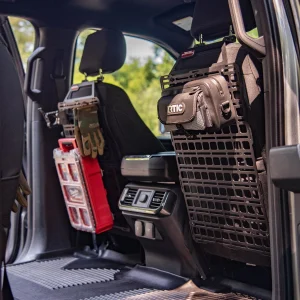
When setting up a custom EDC setup in a vehicle, “strapping” things to the seat is not always viable, especially for overland rigs where unsecured gear becomes a projectile hazard during a rollover. BuiltRight Industries moves away from polymers and utilizes metal “Tech Plates” designed to bolt into OEM mounting points.
Instead of relying on headrest posts, these panels replace plastic trim pieces or bolt directly into dash trays (common in the Ford F-150 series). The rigidity here is absolute. There is zero flex, which is necessary if you are mounting heavier electronics like GMRS radios, fire extinguishers, or tablets on a RAM mount arm. The metal construction handles the vibration of washboard roads significantly better than plastic, which can develop stress fractures at the bolt holes over time.
While a full dash kit typically retails for $60, you can find universal trim plates starting at $35 for smaller applications.
Metal-on-metal mounting requires thread locker. In my testing, vibrations from daily driving will back out standard screws within a month. Furthermore, if you mount a hard item (like a knife utilizing a metal clip) to a metal BuiltRight panel, the audible rattle will be maddening. I recommend lining the back of any metal mounting clips with a strip of electrical tape or soft-side velcro to act as a gasket and silence the setup.
The Attachment Problem: Clips vs. One-Wrap
A major friction point for users is the difficulty of unweaving MOLLE gear. Traditional Malice clips or stiffened nylon straps are designed for semi-permanent attachment on plate carriers. Moving them from a truck panel to a backpack insert is a ten-minute fight requiring needle-nose pliers.
The superior method for Rigid MOLLE Panels is Velcro One-Wrap. Because the RMP has physical holes rather than just webbing loops, you can pass a strip of One-Wrap through the grid, around the item, and secure it to itself. This holds lighter gear (tourniquets, flashlights, multitools) securely but allows you to strip the gear off the panel in seconds to relocate it 2 inches to the left. It saves dexterity and time.
Pelican Ez-Click Systems
For those moving gear between hard cases, Pelican’s Ez-Click system creates a quick-detach functionality. It uses twist-lock knobs rather than screws. This solves the “Bag Transfer” headache by letting you rip the entire organized panel out of a Pelican 1500 case and potentially dock it into a wall mount, though proprietary compatibility limits this to the Pelican ecosystem. While the convenience is high, the price premium hangs around $60 just for the panel insert.
If you cannot justify spending $50 on a branded RMP, go to Walmart and buy a thin, HDPE plastic kitchen cutting board for $5. It is the exact same material as premium tactical panels. With a jigsaw and a drill, you can cut it to the exact shape of your laptop sleeve and drill mounting holes exactly where your holster or pouch lines up. It lacks the universal grid, but for a fixed loadout, it is functionally identical to the high-end option.